
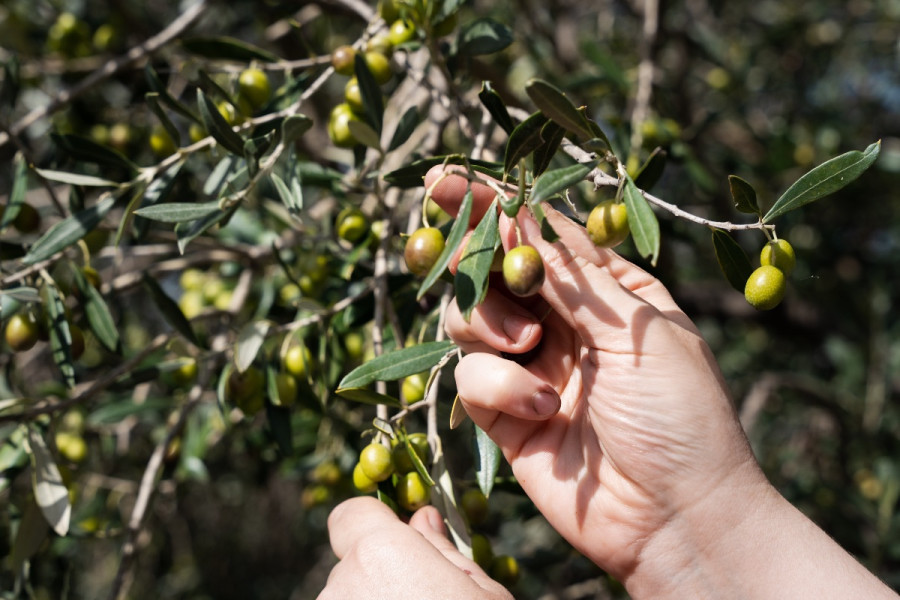
At the height of harvest, the Ramov olive mill runs through the night. Step inside our mill in Stankovci, follow olives from delivery to fresh oil, and meet two oils made here.
At the height of harvest in Stankovci, you can catch the same scene early in the morning or in the middle of the night. Crates are being emptied at intake, the scent of freshly crushed olives drifts from the mill, and at the far end of the line fresh oil is already filling a container. One grower is collecting their oil while another is just arriving with olives. The same line also produces our Ramov Premium and Ramov Blend.
A day at the mill really begins while the olives are still on the tree. Once we agree on a milling slot, the grower can plan the harvest and transport, and we can schedule the work in the mill. In harvest season, that schedule can change by the hour. Rain postpones picking, a grove yields more than expected, or someone gets held up on the road. The intake team keeps growers informed about when to set off, while the mill crew tracks what is already in process and prepares for the next arrivals.

Milling olives in Stankovci, from delivery to mixing
When the olives arrive, we weigh them, remove the leaves and wash the fruit. They then go into the mill, which crushes them into a paste. This is when you first notice the fresh, green scent of crushed olives. At the height of harvest it lingers in the mill for the whole shift.
From the mill, the paste goes into our malaxers, the mixing tanks we call gramole. Slow mixing allows tiny oil droplets to come together into larger ones that are easier to separate. We usually mix for 35 to 40 minutes, monitoring the temperature and keeping it at or below 27 °C during processing. While one tank is running, the team prepares another for the next batch.
Our Stankovci mill is certified for organic production. It is where we make our certified organic extra virgin olive oil from olives grown on Dugi Otok and in Ravni Kotari. Fruitiness comes first, followed by mild bitterness and a peppery finish that lingers. Ramov Premium 500 ml

How we separate the oil in the decanter and separator
After mixing, the paste goes into a two-phase decanter. Centrifugal force inside its horizontal drum separates the paste into two streams. The oil phase comes out on one side, and wet olive pomace, which holds the solids and most of the water from the fruit, comes out on the other.
The oil from the decanter can still carry a little water and fine particles. It passes through a separator, which uses centrifugal force to remove them. Fresh oil then flows into the collection container.
This is when the conversation turns back to the harvest. Was the fruit riper this year? How did last year’s oil taste? Some growers are surprised by how differently the same variety can express itself from one season to the next. It is still one of our favourite moments at the mill. After a shift spent talking about schedules and kilos, we finally get to talk about flavour.
How much oil do olives yield?
We hear this question at the mill almost every day. An oil yield of 12% by weight means we obtained 12 kg of oil from 100 kg of olives. Growers often talk in litres, so it is worth checking whether the figure means litres or kilograms of oil per 100 kg of olives.
Yield varies with the olive variety, ripeness and the amount of water in the fruit. Two batches of the same weight can therefore produce different amounts of oil. The yield tells us how much oil came out of the mill. We talk about aroma and flavour once we taste it.

When an olive oil customer brings his own olives
Aleksandar Stanić from Kruševo has bought our oil for years. He says he likes its character, flavour and mild pepperiness. In the season when we filmed his testimonial, he decided to bring his own olives to our mill. Stankovci was out of his way, but he made the trip from Kruševo anyway.
After milling, he told us he was very happy with the service and with how we processed his olives. That meant a lot to us. Aleksandar first got to know Ramov through the oil he bought, and then he trusted us with his own harvest.
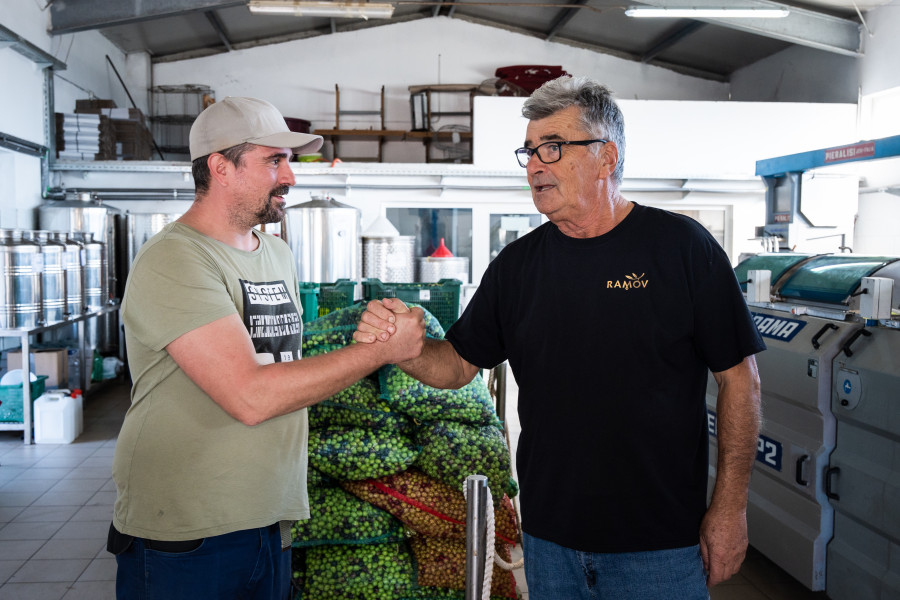
Twenty-five years since our first milling season in Zaglav
We started in 2001 in Zaglav on Dugi Otok. Since 2011 we have milled olives in Stankovci, in the Ravni Kotari region. Over those 25 years, the mill and equipment have changed. Every harvest has taught us something about keeping work moving when ripe olives, rain and a full schedule all arrive within a few days.
You can see how well the team works together at shift change. The incoming crew knows what is in the mixing tanks, whose oil is coming through the separator and what is due next at intake. This is also where we make Ramov Blend, a blend of Oblica, Krvavica and Leccino with gentle fruitiness and a measured peppery finish. You can start a stew with it and finish the same dish with a drizzle at the table. Ramov Blend 500 ml
To taste the two oils side by side, pour a little of each into separate saucers and try them with the same bread. You will soon notice the difference between the gentler Blend and Premium’s more pronounced finish.


